
The air quality is expected to improve further due to wind speed favourable for the dispersion of pollutants.

A tormenting heatwave swept through North India on Sunday with the mercury crossing 49 degrees Celsius in pockets of Delhi, while the weather office forecast some relief Monday onwards.

'It is important to understand that the disability is not in the person.' 'The problem lies in societal attitude and the discriminatory treatment given to disabled people in our country.'
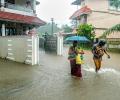
A Red alert, indicating heavy to very heavy rains of over 20 cm in 24 hours, has been sounded for Thiruvananthapuram, Kollam, Pathnamthitta and Alappuzha districts on December 3, while Orange alert (6 cm to 20 cm rains)for Kottayam, Ernakulam and Idukki districts the same day.

The India Meteorological Department has issued a 'Red Alert' and predicted 'very heavy' to 'extremely heavy' rainfall across several districts of Assam over the next five days.

Isolated heavy rains have also been forecast over some places during the next 48 hours.

East and northeast India recorded 29 per cent rain deficit -- 141.5 mm against the normal of 199.9 mm -- from March 1 to May 3.

British supermarkets and pubs are set to enjoy a boost to trade this weekend as families and friends gather for breakfasts and barbecues to watch England's Lionesses play Spain in the Women's World Cup soccer final in Australia.

Of these four flights (except Qatar Airways) returned to Kozhikode airport as the weather condition in Kozhikode gained normalcy.

The weather department has ruled out any respite from the sweltering heat in the coming days and local government officials have asked people not to venture out in the scorching sun.

A punishing cold wave swept Delhi on Monday morning with the minimum temperature at the Safdarjung observatory, the city's base station, plunging to 1.4 degrees Celsius, the lowest in the month since January 1, 2021.

Delhi's minimum temperature on Wednesday morning plunged to 4.4 degrees Celsius -- the season's lowest -- making the national capital colder than Dharamsala, Nainital and Dehradun.

The country also reported 1,750 deaths due to extreme weather events such as floods, cyclonic storms, heavy rain, landslides, lightning, among others, during the year, it said.

The south-west monsoon on Tuesday started withdrawing from parts of south-west Rajasthan and adjoining Kutch in Gujarat, with at least eight states, including rice bowl states of Uttar Pradesh and Bihar reporting deficient rains. It was for the first time since 2016 that the monsoon started withdrawing in the third week of September. "Southwest monsoon has withdrawn from parts of southwest Rajasthan & adjoining Kutch today, against its normal date of withdrawal from southwest Rajasthan of September 17," the India Meteorological Department (IMD) tweeted.
Taps supplying water to households were frozen due to the cold.

Schools and colleges in the city and adjoining districts have been closed as a precautionary measure.

'...to prevent this episode from disrupting ongoing cooperation.' 'The discovery of this plot had the potential to derail much of what has been achieved in the relationship during this administration's tenure -- I don't think that fact has been sufficiently appreciated in India.'

A severe cold wave brought the minimum temperature down to a numbing 1.5 degrees Celsius at the Ridge weather station in central Delhi.

Rediff.com's Utkarsh Mishra visits the Kashi Vishwanath-Gyanvapi mosque in Varanasi, which is fast being turned into another mandir-masjid dispute.

The low-pressure area over the South Andaman Sea and adjoining southeast Bay of Bengal is very likely to move northwestwards and intensify into a depression by Saturday, the weather office said.

The weather department has forecast widespread snowfall or rains over the next two days also.

Operations at the Delhi airport remained normal. However, three flights were returned or diverted to the Delhi airport due to bad weather in Chandigarh, Varanasi and Lucknow on Tuesday night.

At the review meeting, chaired by cabinet secretary Rajiv Gauba in New Delhi, the IMD said above normal maximum temperatures are likely over most parts of northeast, east and central India and some parts of northwest India.

In the coming months, globally as well as in India, rice might remain a hot potato.

The southwest monsoon is set to make its exit in style, bringing rains to the parched parts of Uttar Pradesh and Bihar, as weather forecasters have picked up signs of formation of a cyclonic circulation over Bay of Bengal. Addressing a press conference in New Delhi, India Meteorological Department (IMD) director general Mrutyunjay Mohapatra on Thursday junked last week's forecast of early withdrawal of southwest monsoon and announced the extended stay of the seasonal showers. "Even though we expected early withdrawal of the southwest monsoon, a cyclonic circulation over west-central and adjoining northwest Bay of Bengal will shift the monsoon trough southwards around September 7.

Monsoon normally starts withdrawing beginning September 1 from west Rajasthan.

Since its formation on June 6 in the southeast Arabian Sea, Biparjoy had maintained a northward track, gathering strength and becoming an extremely severe cyclonic storm on June 11, packing wind speed of more than 160 kmph, and then losing intensity a day later.

Monsoon normally hits Kerala on June 1 but this year, Met department had predicted that it will hit the state on June 5.

Intense monsoon rains brought normal life to a standstill in several parts of eastern and central Rajasthan, flooding out roads, rail tracks, low-lying residential areas and hospitals and claiming seven lives since Sunday night.

Weather scientists attribute the early onset of southwest monsoon over Kerala to the influence of the remnants of cyclone Asani that triggered the cross-equatorial flow, a key factor for the seasonal rains.

The weather system remained practically stationary during the last six hours and weakened to a depression, and is likely to turn into a well-marked low pressure area during the next 12 hours, it said in a bulletin.

The mercury soared to 46.2 degrees Celsius at Najafgarh, making it the hottest place in the capital.

'It is very likely to move nearly northwards for next few hour and recurve slowly north-northeastwards along Narsapur, Yanam, Kakinada, Tuni and Visakhapatnam coasts during noon to evening on Wednesday and emerge into west central Bay of Bengal off North Andhra Pradesh coasts by night,' the India Meteorological Department said in its national bulletin.

Rain or thundershowers have also been predicted in south interior Karnataka and at a few places over Coastal Karnataka and North interior Karnataka.

Tourism is badly affected. Entire apple orchards have been washed away. 2 million people are threatened with loss of livelihood.

The IMD has fancy weather-monitoring radars in the name of providing better forecasts.

Rauf Azhar, born in 1974 in Pakistan, had been sanctioned by the United States in December 2010.

Kharif crops were sown in only 4.15 lakh hectares against the target of 28.27 lakh hectares till July 21 or only in 14.71 per cent of the arable land.

The India meteorological department has issued a yellow alert, warning of a fresh heatwave spell in Delhi which may see temperatures soaring to 44 degrees Celsius by Wednesday.

It rained in the periphery of Delhi -- Aligarh in Uttar Pradesh and Karnal in Haryana -- but clouds hovered over the national capital, without giving any relief from the heat.
